Preparing the bodywork before the film: why it is half the job
It is the part of the job that never appears in the finished photos and the only part that cannot be redone later. Once the film is on, what is underneath stays untouched for years.
Reviewed by Sergio6 min read
Whatever gets sealed in, stays
Vinyl and film are adhesives: they stick to whatever is underneath and copy its shape. PPF is clear and disguises nothing, so a swirl or an embedded iron particle is still visible, only now it cannot be corrected. Under coloured vinyl the defect is not seen, but it is felt: any particle under the adhesive leaves a raised dot that shows up in grazing light.
That is why preparation weighs so much in the quote. It is not an extra: it is the part of the job that can only be done once, and the next opportunity arrives when the material comes off, three or five years later.
A new car is not a clean car
It is the most widespread idea and the least accurate. A newly registered car arrives with transport contamination, metal particles from the railway or from the compound itself, remains of the protective film and, depending on the season, resin or Saharan dust.
The difference from a used car is not that one needs preparation and the other does not. It is that on a new car the preparation is short and hardly ever includes correction, while on one with years of tunnel washes the correction can be most of the work.
The order matters and is not negotiable
Skipping a step or moving it has concrete consequences. Polishing before decontaminating means dragging metal particles across the clear coat with a machine.
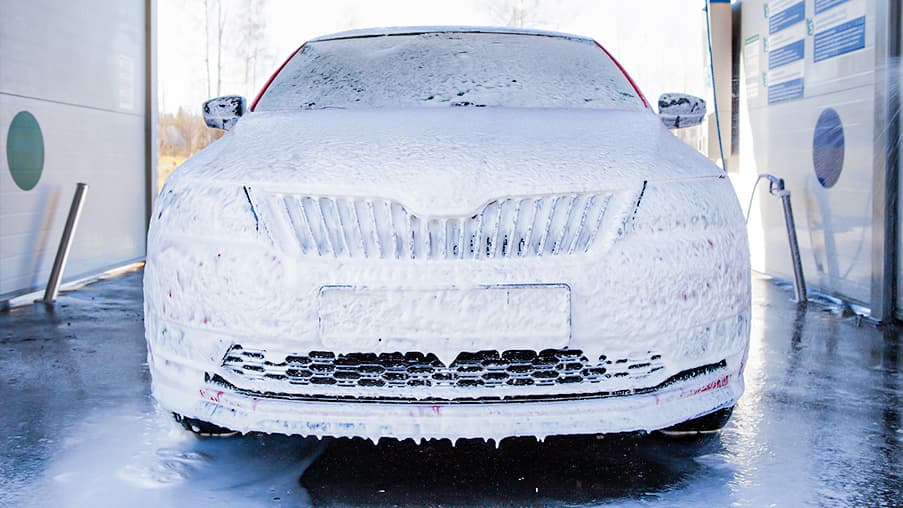
- Safe wash: foam pre-wash, two buckets, wheel arches and seals, drying without dragging a towel.
- Chemical decontamination: iron remover over the whole body and tar solvent on the skirts and lower panels.
- Mechanical decontamination with clay wherever the clear coat still feels rough.
- Diagnosis under dedicated lighting and thickness measurement, with the paint already clean.
- Correction where it is needed, local or full depending on what the measurement says.
- Edges, door frames and the perimeter of the light units, which is where the material goes in.
- A final degrease, right before the car moves into the installation bay.
Why a freshly waxed car is not ready
Waxes, sealants and the oils left by polishing are exactly what stops the adhesive from anchoring. That is why the process always ends with a degrease, and why bringing the car straight from a wax tunnel saves nothing: that layer has to come off before we start.
The critical point is the edges. The middle of a panel forgives almost anything; an edge with product residue starts lifting within a few months, and that is where you see, two years later, whether the preparation was rushed.
Correct, yes, but with judgement
Clear coat is finite and every polishing pass consumes part of it. That is why we measure before deciding, and why sometimes the right answer is to correct less than the customer expected: what comes off today is no longer available in five years, when the film comes off and the car needs it again.
There are also cars where correction is what genuinely changes the result: under clear PPF, a clear coat full of swirls looks exactly as bad as it did before, and that defect stays fixed for years.
What preparation does not fix
When one of these turns up, we show it on the car before starting. It is not a formality: it changes what can be promised about the result and, in some cases, changes the coverage we recommend.
- A scratch your fingernail catches on, because it has already gone through the clear coat.
- Knocks, dents and lifted panel edges.
- A clear coat already thinned by previous corrections, which will not take another pass.
- Rust or lifting paint, which would keep spreading under the film, out of sight.
- Poorly bonded resprays, which react to polishing differently from the original clear coat.
Why two identical cars do not cost the same
Same model, same film package, separate quotes: the difference is almost always here. One arrives with sound clear coat and needs a wash, decontamination and degrease; the other arrives after years of roller tunnels and needs a one- or two-stage correction on top.
It is also the line where quotes vary most between workshops. If you are comparing two offers, the question that explains the gap is not which film they fit, it is which preparation they include before fitting it.
FAQ
Can I bring the car washed to save on preparation?
It helps in that the car arrives without mud, but it replaces nothing. The wash we do is technical and part of the process, and decontamination and degreasing still have to follow.
How much does preparation add to the quote?
It depends entirely on the starting condition, which is why there is no single figure. On a newly registered car it is a small part; on an older one it can be the largest part of the job.
Does a new car need preparing?
Yes, even if it is a short preparation. What a new car hardly ever needs is correction, and correction is the expensive part.
What if I have a resprayed panel?
It gets assessed separately. A respray responds to polishing differently from factory clear coat and is the area most at risk when the material comes off years later.
Can vinyl go over an area with rust?
No. Film does not stop rust, it only covers it, and underneath it keeps spreading unseen until the film comes off. That area has to be repaired before the car comes in.