Safe washing
Foam pre-wash, hand wash with the two-bucket method, wheel arches, wheels and shut lines, and drying with air rather than dragging a towel across the paint. No brushes: there is no sense in adding marks right before correcting them.
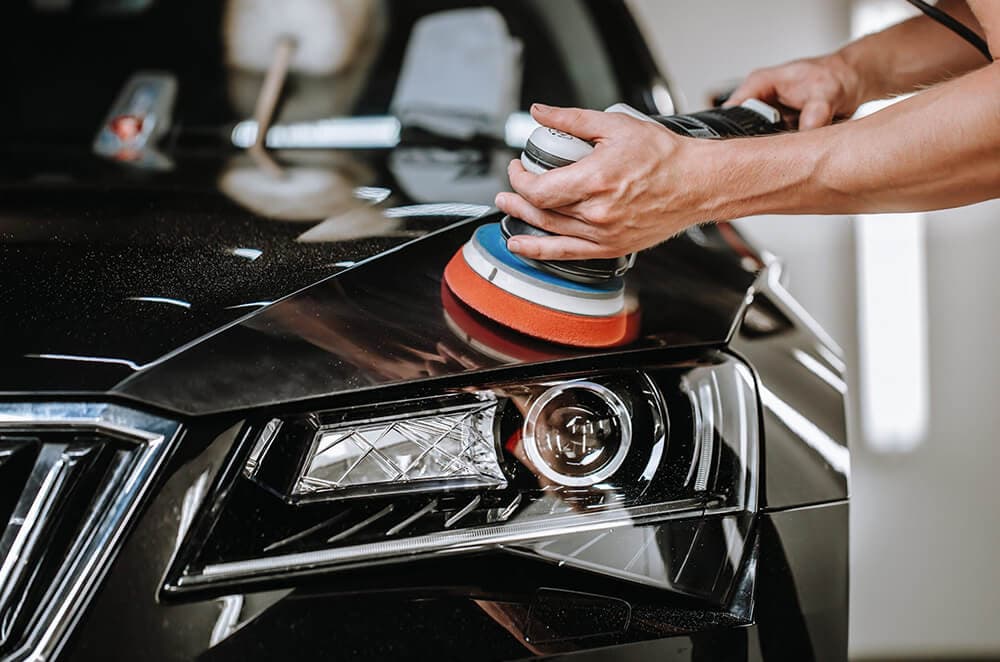
Vinyl and PPF are adhesives, and they stick to whatever is underneath. What is not corrected first stays sealed in for years: swirls, iron particles, tar residue. Preparing the bodywork — safe washing, decontamination, clay, correction where it is needed and degreasing — is half the work of a wrap or a PPF job, even though none of it shows in the photos of the result.
It is not an extra on the job. It is the part that cannot be redone afterwards: once the film is on, what lies underneath stays untouched until it comes off, three or five years later.
PPF is clear and hides nothing. A swirl, an embedded speck of iron or a trace of tar is still down there, and on dark paint it shows against the light exactly as before, except that now it cannot be corrected.
Under coloured vinyl the defect is not visible, but you can feel it: any particle under the adhesive leaves a raised dot that catches the light at a low angle and, from a metre away, shouts louder than the colour you chose.
Waxes, sealants and the oils left by polishing are exactly what stops the material bonding. That is why preparation always ends with a degrease, and why a freshly waxed car is not a car ready to be wrapped.
Edges are the critical point. The middle of a panel puts up with almost anything; an edge with product residue on it starts lifting within a few months. That is where you see whether the preparation was rushed.
from dirt to clearcoat ready
Foam pre-wash, hand wash with the two-bucket method, wheel arches, wheels and shut lines, and drying with air rather than dragging a towel across the paint. No brushes: there is no sense in adding marks right before correcting them.
A dedicated product over the clearcoat to dissolve what washing does not take off. It is the step that leaves the paint in a state where you can genuinely judge which defects are there and which are not.
Brake dust and metal filings from traffic embed themselves in the clearcoat and rust inside it. The iron remover dissolves them and turns them a different colour so they can be seen. Under film they would stay as permanent dots.
It gathers on side skirts, lower door edges and behind the wheels, exactly where PPF and vinyl put their edges. It is dissolved with a dedicated product and dwell time, never by rubbing.
Whatever is still embedded after the chemicals is drawn out with clay and lubricant. When it is done the clearcoat feels smooth again, and that smoothness is exactly what the film needs to settle without dots.
Before polishing we inspect under dedicated lighting and measure the thickness. If the clearcoat is marginal, we correct less, and we tell you: burning clearcoat to gain half a point of gloss under a film is not worth it.
Often the whole car does not need polishing. We correct the areas that ask for it — bonnet, wings, door handle recesses — with the mildest abrasive that clears the defect, and leave the rest alone.
On cars with years of roller washes behind them, a one- or two-step correction is the only way the colour will look deep under clear PPF. Removing the swirls before a coating or a film is decided with the clearcoat measured, not by default.
Door frames, the bonnet edge, the handle recess and the perimeter of the light units. That is where the film tucks in, and where product from previous washes builds up; if it is not cleaned, the edge ends up lifting.
The last pass before the car goes into the installation bay, to remove polishing oils and silicone residue. It is the shortest step of all, and the one that decides whether the material sticks.
If the job includes PPF on the light units, the headlight is sanded and polished first. The film is clear and would seal the yellowing in; with the headlight brought back, protecting it makes sense.
Before the film touches the car
We inspect the clearcoat under dedicated lighting and measure its thickness. That tells us which defects are there, which can be corrected and which cannot, and we show you on the car before we start.
Foam pre-wash, two-bucket hand wash and air drying. Wheel arches, wheels and shut lines are cleaned too, because otherwise dirt keeps coming out of them for the rest of the process.
Iron remover over the whole body, and tar solvent on the sills, side skirts and behind the wheels. Polishing without taking that off means dragging particles across the clearcoat.
Mechanical decontamination with clay and lubricant wherever it still feels rough. The check is simple and never lies: your hand on clean clearcoat has to slide without finding grit.
A test patch to match pad and abrasive to that particular clearcoat, then correction panel by panel with pressure and temperature under control. Local if the car allows it, full if its condition demands it.
We take off whatever comes away without forcing it, clean the edges and shut lines and make the final degreasing pass. The car goes to installation with the surface finished, not half done.
The process is the same; what changes is how much weight each step carries. These are the three cases that come into the workshop.
| New car | Older car | Car with an old wrap | |
|---|---|---|---|
| Safe washing | Yes | Yes | Yes |
| Chemical decontamination | Light, transport residue | Full | Full, once the film is off |
| Tar and metal particles | Uncommon | Nearly always | On the sills and side skirts |
| Clay | Only where grit can be felt | Yes | Depends how the clearcoat comes out |
| Adhesive residue | No | No | Yes, with heat and a mild solvent |
| Correction of defects | Local: transport or delivery marks | From local to two steps, depending on condition | Common on edges and where the vinyl was pulled |
| Full polish | Rarely | When the clearcoat needs it and can take it | Only if it was already marked under the vinyl |
| Clearcoat measurement | Yes | Yes, and it decides more than anything else | Yes |
| Edges and shut lines | Yes | Yes | Yes, with attention to adhesive residue |
| Extra time in the bay | Little | The most variable of all | Depends how the old vinyl comes off |
A newly registered car does not arrive perfect: transport, the dealer wash and the delivery wax leave marks and a layer that has to come off. What it does save you is correction, because the clearcoat is sound.

Rating on Google
José Joaquin Godoy Haro
4 months ago
En Xwrap me abrieron un hueco para realizar un trabajo de vinilado en mi coche (cambio de color del parachoques). Quedó estupendo, buen trato, varias maneras de pagar y eso que me retrasé en la recogida. ¡Los recomiendo!
Thibaut Merlange
7 months ago
I contacted Xwrap to apply a dark vinyl wrap to protect my rims and give them a more aggressive look. They gave me excellent advice and did a top-notch job. I highly recommend them; they are very professional.
Saifa D
5 months ago
Very satisfied with the service. Full wrap in Avery Dennison satin black vinyl on my BMW X5, impeccable result. Deadline met, meticulous work, attentive team. I came all the way from France specifically for this and it was definitely worth the trip. I recommend them without hesitation. ⭐⭐⭐⭐⭐
Luismi Ferreres Martínez
5 months ago
A very thorough and high-quality job on the entire car: PPF, polishing, ceramic coating, wheels... and especially the vinyl wrap during the Chrome Delete service. Very happy with the result and the service.
the time is the cost
What you pay for here is hours in the bay and on the machine, not product. Two cars of the same model can take a morning or three days depending on how the clearcoat arrives, so preparation is priced on the actual vehicle and closed alongside the quote for the vinyl or the PPF.
Quoted within the wrapping, PPF or ceramic coating job.
Always includes the wash and the decontamination beforehand.
Ask for a personalised assessment by sending us photos of the car, ideally in full sun and of the worst areas you can see: swirls only show up in direct light. Cleaning the interior is not part of this preparation, but it is available on request within the job.
Yes, for two separate reasons. One is adhesion: on wax, silicone or polishing oil the material does not bond and the edges lift. The other is appearance: PPF is clear, and vinyl copies the relief of whatever is underneath, so any particle or mark is locked in for the whole life of the film.
Yes, though far less of it. The clearcoat is sound, but the car arrives with delivery wax, transport residue and sometimes marks from the dealer wash. It is washed, decontaminated, degreased, and only the specific spots are corrected. It is the cheapest of the three cases.
The ones inside the clearcoat, yes. If your fingernail catches in the scratch, it has reached the colour coat or the primer: its appearance can be improved, but it cannot be removed. That is body shop work, and it is worth sorting before anything goes on top.
The clearcoat has a limited thickness and every correction uses some of it. That is why we measure first and choose the mildest abrasive that clears the defect, rather than always going to two steps. If the clearcoat arrives thin from previous work, we tell you and adjust what is realistically achievable.
The wash, the decontamination and the degrease are: without them nothing gets installed. Paint correction is priced separately, because it depends entirely on the state the car arrives in and can run from a local touch-up to two days on the machine.
On a new car, a few hours within the same day as the installation. On an older car with heavy swirling, preparation can take up more bay time than the film itself. We give you the exact days when we close the quote, not afterwards.
It comes off with heat and a mild solvent, never by scraping, and then we assess the clearcoat that appears underneath. Sometimes it comes out better than expected because the vinyl protected it; other times there are dull patches or pull marks on the edges that have to be corrected before anything goes back on.
A couple of photos in full sun and the model of the car are enough for us to tell you what preparation it needs before vinyl or PPF, and how much bay time that adds.
Av. de Peris i Valero, 68, Quatre Carreres, 46004 València, Valencia
The map is loaded by Google. Showing it connects your browser to their servers.
Most of the cars that come into the workshop to be wrapped or protected do not have a colour problem, they have a surface problem. Years of automatic washing leave a web of circular marks that break up the reflection, and on top of that there is iron from traffic embedded in the paint, tar along the sills and a build-up of product. All of it sits between the panel and the material we are about to install.
In Valencia the clearcoat also collects salt if the car sleeps near the coast, and organic fallout for most of the year. That is why chemical decontamination and clay are not a luxury before PPF: they are what lets the film settle on a smooth surface instead of on grit. The check is done by hand, and it does not lie.
Correction is decided with the clearcoat measured. Removing the swirls before a coating or clear PPF completely changes how the car looks afterwards, but polishing does not fix everything: a scratch you can feel with a fingernail has gone through the clearcoat and needs a body shop, and a clearcoat already thinned by earlier corrections will not take another aggressive pass. We would rather say that up front than promise it will look like new.
The process always ends the same way: clean edges, shut lines checked and a final degreasing pass. From there the car goes into the installation bay with the surface ready, which is the only way a vinyl or a PPF lasts its three to five years without lifting at the edges.