Protecting the interior: piano black, screens and rub areas
The piano black on the centre console is the first surface to go on almost every current car, and it is the one nobody protects on day one.
Reviewed by Sergio5 min read
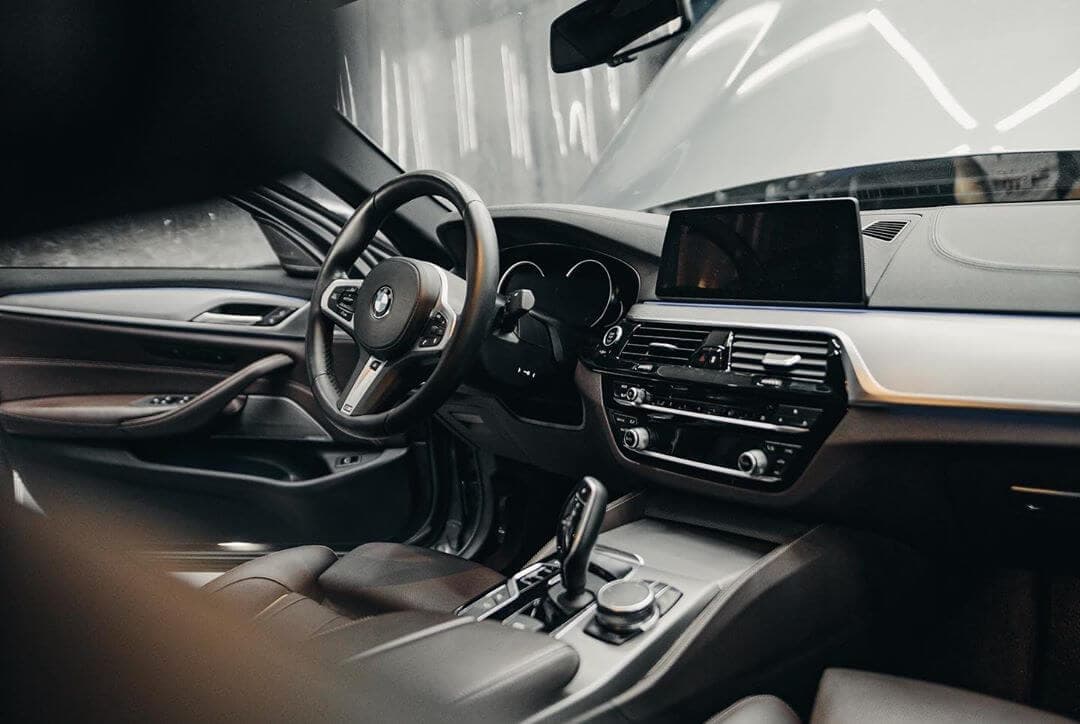
Piano black scratches on its own
That is not an exaggeration: it is a gloss lacquer over plastic, far softer than the clear coat on the body, and it sits where the most hands land. The dust that settles on it acts as an abrasive every time a cloth goes over, so the marks appear while cleaning, not while getting dirty.
And unlike bodywork, this surface is not corrected. A console panel does not take the polishing a bonnet accepts, partly because the lacquer is barely thick enough and partly because many parts carry printed graphics and edges that cannot be touched.
What gets protected inside the car
It is clear film cut to the pattern of each part, the same kind of material that goes on the outside. It goes onto a clean, degreased surface, and on small parts any speck or fibre left underneath shows far more than it would on a bonnet.
- Gloss inserts on the centre console and the transmission tunnel.
- The frame and surface of infotainment and instrument screens.
- The area around buttons, control wheels and the gear lever or selector.
- Door cards and interior pulls, where rings and keys rub.
- Decorative trims and dashboard surrounds.
- The sill and the inner door edge, which suffer every time someone gets in.
- The base of the wireless charger and the cup-holder recess.
Screens: what to decide beforehand
A screen is not a decorative panel. Putting film over it changes how the touch surface feels and can change how reflections behave, particularly on screens with a factory anti-glare treatment. On some models the result is excellent and on others it is not worth it.
That is why this decision is taken with the car in front of us rather than from a catalogue. We would rather say no to one particular screen than hand back an interior where the navigation responds worse than it did before.
What it does not fix
If the console is already marked, the conversation is a different one: what is left is living with it or replacing the part. Film there only serves to stop it getting worse.
- It does not recover an already scratched part: the film is clear and the marks stay underneath, on show.
- It does not protect against an impact: if something strikes a trim edge-on, the trim suffers all the same.
- It does not replace cleaning: the surface still collects dust and the dust still has to come off properly.
- It does not cover upholstery, leather or textiles, which need a different water-repellent treatment.
- It does not repair a part that is chipped or whose lacquer is already lifting.
When it makes most sense
- A newly registered car
- The best case, because the surfaces are untouched. It is the only moment when the protection preserves the original state instead of freezing damage that is already there.
- Rental or lease
- The interior counts in the handback assessment, and scratched piano black is one of the things most noticed in an inspection.
- A family car with child seats
- Door edges, the backs of the front seats and the sill take more knocks than any part of the dashboard.
- A car that is already at the workshop
- If the vehicle is staying several days for a wrap or a PPF job, adding the interior does not mean a second appointment.
How to clean it afterwards
With a clean, slightly damp microfibre, never dry on a dusty surface. Working dry just drags particles across the film, which is exactly what you were trying to avoid.
No solvent-based products, no dashboard shine and no all-purpose wipes: they leave uneven gloss and some attack the material. A neutral interior cleaner is enough.
FAQ
Can you see the film over piano black?
With the part properly prepared, barely: the material is clear and follows the shape. Where it can show is at the edge, which is why the cut is taken right to the edge of the part whenever the geometry allows.
Can it be removed later?
Yes, it is reversible. Underneath, the surface is exactly as it was when the film went on, which is the whole point.
What if the part is already marked?
The film fixes the marks, it does not erase them. It can still be fitted to slow the deterioration, but you should know that what you see now is what you will keep seeing.
Does the dashboard have to come apart?
It depends on the model and the part. Many inserts are done in place; others come out easily and are done on the bench, which always gives a better edge. We assess it with the car in front of us.
Does it work for the steering wheel and leather too?
No. Leather and textiles need a water-repellent treatment, not a film. They are different things and are quoted separately.