How to wash a wrapped or PPF car without damaging it
Almost all the damage we see on vinyl or PPF starts at an edge, and it is nearly always driven in by a pressure-washer lance. This is the wash routine we recommend, in order.
Reviewed by Sergio6 min read
The weak point is always the edge
Vinyl and PPF are films: however neatly they are finished, they have to end somewhere. That edge is the only place water and dirt can get underneath, and it decides whether the job lasts for years or starts lifting in its first winter.
That gives us the rule that sums up this guide: keep the pressure jet perpendicular to the surface and at a distance. Never angle it into an edge, a join or the perimeter of a light. One bad session with the lance held close does more damage than a whole year parked on the street.
The wash, in order
- Rinse first with plenty of water, working from top to bottom, to carry away loose dust before touching anything.
- Apply foam or pre-wash and let it work, without allowing it to dry in the sun.
- Rinse off the foam before using the mitt.
- Wash by hand with two buckets: one with shampoo and one with plain water to rinse the mitt every few passes.
- Work from top to bottom and panel by panel, starting with the roof and glass and finishing with the skirts and lower sections.
- Use a separate mitt or microfibre for the lower sections, wheel arches and wheels.
- Rinse thoroughly at the end, paying attention to joins and door frames where shampoo collects.
- Dry straight away with a clean microfibre towel or air.
At a self-service car wash
You can wash a wrapped or PPF-protected car at a self-service wash, and plenty of people do. You only need to follow two rules.
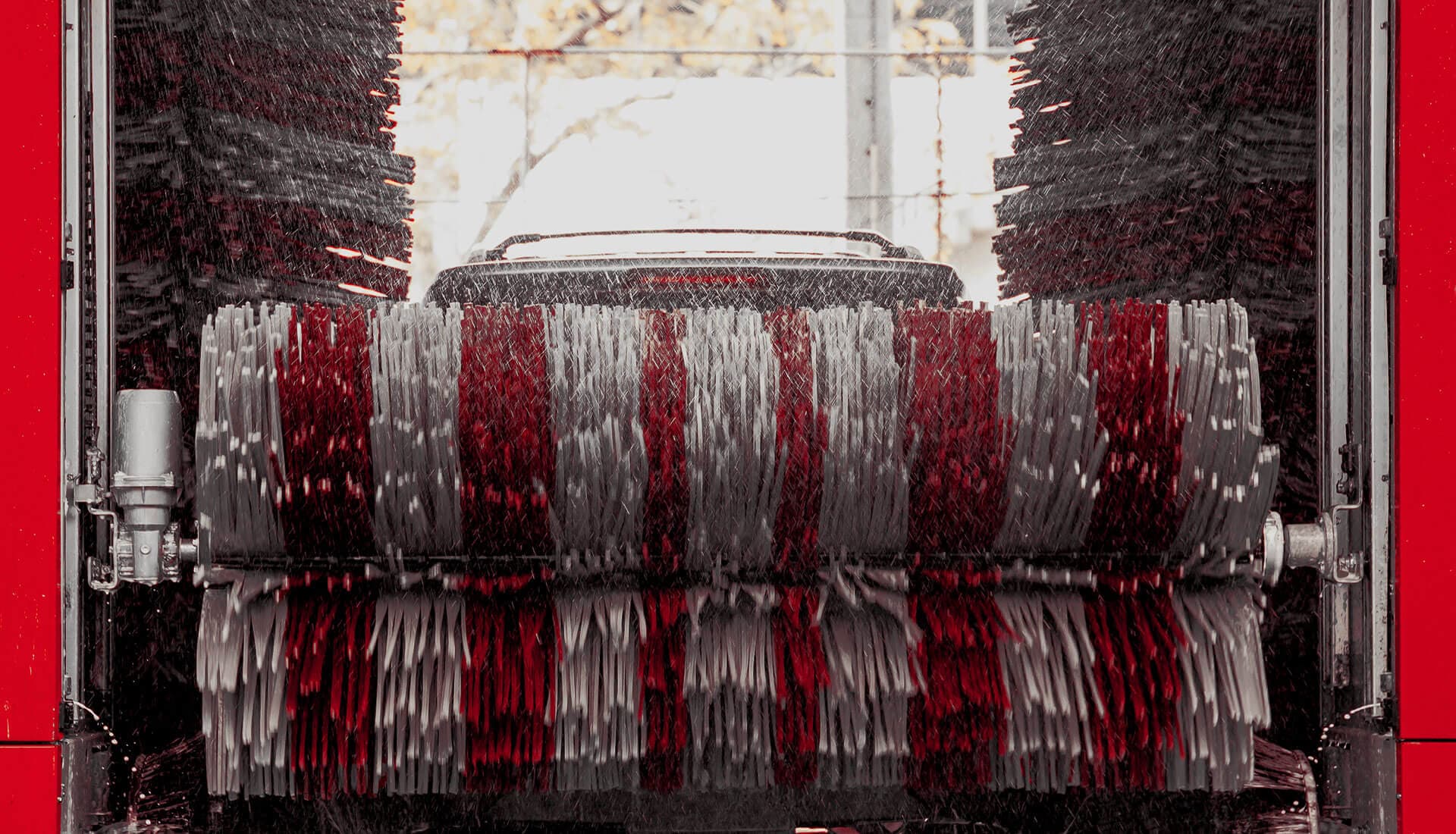
First: do not touch the bay brush. It has cleaned the lower sections of vans all day and carries grit in its bristles; using it on film is like rubbing it with sandpaper. Second: keep the lance at a distance and square to the surface, never aiming it at an edge, a trim join or the perimeter of a protected headlight.
The rest of the programme — pre-wash, foam and rinse — is useful. What is missing is drying, so take your own microfibres: allowing water to evaporate in the sun is what leaves limescale marks.
What changes between vinyl and PPF
- Clear PPF
- It handles washing well, and on many films light micro-scratches self-heal with the warmth of the sun. Its edges, however, are just as sensitive as those of vinyl.
- Gloss vinyl
- It washes like paint, except that it cannot be polished. Any mark made with an abrasive stays there.
- Matte or satin vinyl
- It cannot take waxes or gloss enhancers, including the final step in many automatic programmes. Use a dedicated shampoo and straight passes.
- With ceramic coating on top
- The easiest setup: dirt sticks less, water runs off and washing stops being a risky moment. It still needs a hand wash or a touchless wash.
Drying is where most people go wrong
Dragging a towel over a car that still has dust on it is exactly how micro-scratches are made. If you rinsed properly, the towel only picks up water; if you only half-rinsed, it picks up grit and carries it across the panel.
In Valencia there is another reason to dry every time: the water leaves limescale, and those white marks show far more on matte or satin than on gloss. Dry in the shade with the microfibre folded, turning it to a clean side when it becomes saturated.
What never to do
- Roller or brush car wash: nothing lifts edges faster.
- Pressure washer held against the bodywork or aimed at an edge.
- Steam at close range over a join or film edge.
- Polishes, cutting compounds or abrasive sponges on film.
- Solvent-based products, and on matte finishes, waxes and silicones too.
- Wiping a dry cloth over dust, inside or outside the workshop.
- Leaving the car to dry by itself in the sun after rinsing.
How often, and the Valencia factor
There is no magic frequency. What makes the difference is not leaving dirt stuck to the surface for days: bird droppings, insect remains and tree sap attack it if they dry on top, and in summer that can happen in an afternoon.
If the car stays on the street near the coast, a clean-water rinse midweek helps more than one thorough wash each month. Salt air builds up right on the edges, where you want it least.
FAQ
Can I use a pressure washer?
Yes, with care. Keep it at a distance, with the jet perpendicular to the surface, and never aim it at an edge, a join or the outline of a headlight. The problem is not the pressure itself, but the angle.
What about a touchless car wash?
It is a valid option when you cannot wash by hand. Check that the programme does not finish with wax if your car has a matte finish, and dry it yourself when you leave.
When can I wash it after fitting?
You need to respect the curing time we give you when the car is handed back, because it varies with the material and the temperature over those days. Until that time has passed, no washing or pressure.
Can I wax a car with PPF?
Products compatible with clear film can be used, but a ceramic coating applied on top is what really simplifies maintenance. On matte vinyl, no wax or gloss enhancer.
Is damage from a bad wash covered by the warranty?
No. Roller washes, direct pressure on the edges and abrasives are external damage, and the terms say so. An edge that lifts without an external cause is a warranty case.