Front PPF or full-car coverage: how far should you go
The question is not how much film to fit, but where your car takes impacts. Once that is clear, choosing a package is no longer just a matter of budget.
Reviewed by Sergio6 min read
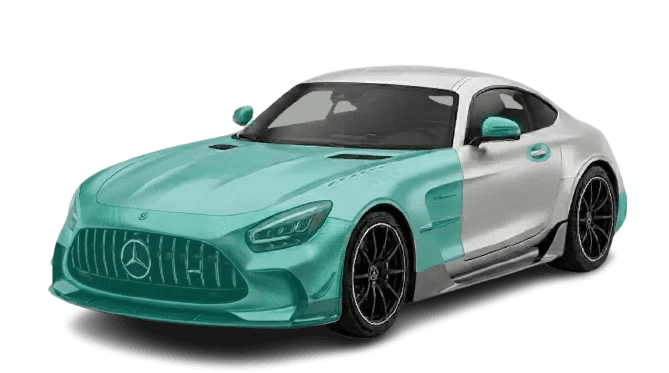
The useful question is not how much film
Almost everyone frames it as a scale: front, more of the front, whole car. Looked at that way, the decision comes down to price alone, and price says nothing about whether the film is where it needs to be.
The question that settles it is different: where does your car take impacts? With motorway driving, damage is concentrated in one very specific area; with other types of use, it appears in places a front package does not touch.
Where paint really gets chipped
The front brings together several panels exposed to road debris without covering the whole car. The sides, roof and rear have different needs; assess those areas before choosing a package.
- Bumper, bonnet and front wings: this is where almost everything thrown up by the car ahead lands.
- Headlights: they are polycarbonate and sit on the front line, so they chip before the bodywork.
- Skirts and lower door sections behind the wheels: constant spray that front coverage does not reach.
- Sills and lower door edges, where shoes and bags rub.
- Handle recesses and the edge of the tailgate, which are marked by fingernails and rings.
- Roof and rear: they take few impacts, which is why these areas are the hardest to justify protecting on their own.
What each level leaves exposed
- Partial front
- Bumper, headlights, mirrors and the front sections of the bonnet and wings. It leaves the rear half of the bonnet exposed and a horizontal cut line that shows under raking light on dark paint.
- Full Front
- Whole bonnet and wings, with no film edge partway across a panel. It excludes doors, sides, roof and rear. Edge finishing is agreed according to shape and access on your car.
- Full-body protection
- Exterior bodywork coverage: front, sides, roof and rear. The quote identifies included panels, possible edge finishes and exclusions; it does not mean protecting every surface or accessory.
Four questions make the decision for you
- How much motorway driving do you do each month? If it is your main use, protecting the whole bonnet pays off; if you drive almost entirely in town, a partial front does the job.
- Where does the car stay overnight? On a narrow street, the sides and sills suffer as much as the front.
- What paint does it have? A three-stage, pearlescent or special factory colour is expensive and difficult to match in a partial repair.
- How long will you keep it? If you keep it for years, or return it at the end of a lease with paint condition as a criterion, film works in your favour.
When full-body coverage is not worth it
We say this with the car in front of us more often than you might think. If the clear coat arrives with uneven-quality resprays, flaking areas or has been left very thin by previous correction, covering the whole car means sealing in a problem that keeps developing underneath.
It also makes little sense on a vehicle you plan to sell soon, or when the budget means cutting back on preparation. Between full-body PPF over poorly prepared bodywork and a Full Front fitted properly, the second option delivers a better result for longer.
What moves the quote
Covered area is only one factor. The shape of the bodywork matters just as much — compound curves and sharp edges are handled piece by piece — as does how many parts must come off to wrap the film around the back and, above all, the condition of the paint when it arrives.
Two cars of the same model with the same package can be priced quite differently if one is newly registered and the other has years of automatic car washes behind it. That is why we finalise the price after seeing the car.
What film does not do
PPF helps against small impacts and scuffs on covered areas but cannot prevent all damage. It does not prevent dents or restore marked clear coat. Nor does it replace body and paint repair when damage already exists.
An impact that pierces the film is exactly what it was fitted for. It has done its job, and that case is not an installation defect.
FAQ
Does it make sense to cover the roof and rear?
It can make sense if you want exterior coverage beyond the front. It does not guarantee undamaged paint for the car’s entire life; scope and exclusions are agreed in the quote.
Can you see the edge of the film on the bodywork?
Very little when the edges are wrapped around the back. Where it does show is the mid-panel cut on a partial front: it is a horizontal line across the bonnet, and on dark cars it appears under raking light.
Is film worthwhile if the car already has stone chips?
It is worthwhile to stop them getting worse, but the existing ones stay underneath and remain visible. If they bother you, we first need to assess what can be corrected and what requires paintwork.
How long does the car stay in the workshop?
A front package takes considerably less time than full-body coverage, which is the longest job we do. The exact drop-off and collection dates go in the quote; we do not guess them.
What does the PPF warranty cover?
Up to 3 years on installation, with the term and conditions written in the quote. It covers application defects with no external cause. Material warranty is specified separately for the film; warranty and service life are not the same.