Satin, matte and gloss vinyl: how they behave in use
They are not three levels of the same finish. They are three surfaces that get dirty differently, mark differently and forgive different things.
Reviewed by Sergio6 min read
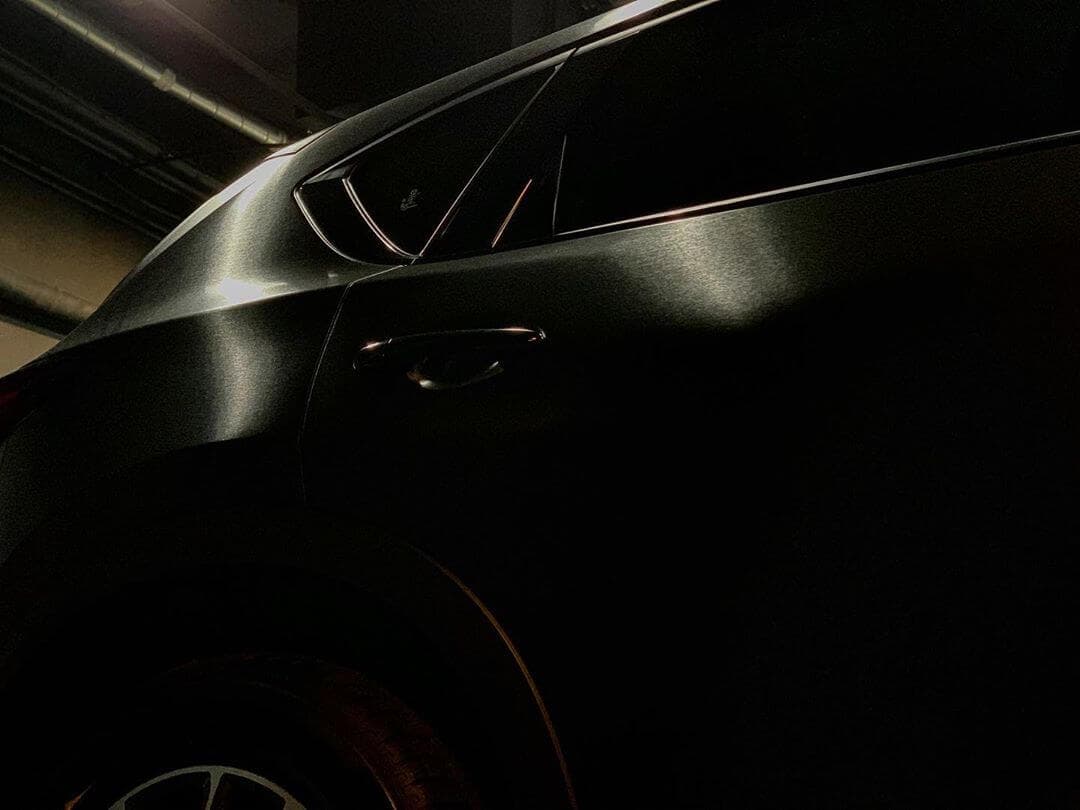
The difference is in how they give the light back
A gloss finish reflects light like a mirror: you see the workshop lamp as a single point. Matte scatters it in every direction, so you see no point at all — you see the surface. Satin sits between the two and gives back a wide, soft reflection.
Everything else follows from that. What a finish hides and what it shows, which stains are visible, where marks of use appear, and what can be done once they do.
Gloss
Its weak point is the sharpness of that reflection: wash marks show exactly as they would on a clear coat, with the difference that here they cannot be polished out.
- It is the closest to paint, so a car wrapped in gloss does not read as wrapped.
- It hides everyday dust well and water spots come off easily.
- It accepts any product compatible with vinyl, which widens the maintenance options.
- Because it reflects like a mirror, it shows every ripple in the panel underneath.
- It is the most rewarding on cars with lots of edges and small surfaces.
Satin
It is the finish most people pick once they see physical samples, and that makes sense: it gives the colour depth without the hard reflection of gloss, and it hides irregularities in the shape of the body considerably better.
Its weak point is wherever hands land. Finger grease around the handle, on the tailgate edge and around the rear badge shows up, and it has to come off soon with a mild degreaser so it does not stay as a mark.
Matte
It is the finish with the most character and the least forgiving of the three. With no reflection to compete, anything that alters the surface is visible: a splash of fuel at the pump, a grease stain, tree resin, a silicone product someone applied without looking.
And the important part: on matte, anything that creates local shine is permanent. Rubbing a stain in circles leaves a satin patch inside the matte panel, and that cannot be corrected. The film is not polished, and there is no way to bring the original texture back to that spot.
- No waxes, silicones or gloss enhancers, not even “just to try” in one corner.
- Matte-specific shampoo and clean microfibres, always in straight lines.
- Organic and fuel stains off as soon as possible.
- If you want to seal it, it has to be with a matte-compatible product.
The rub areas, where it is actually decided
On matte and satin, wear does not arrive evenly: it concentrates in four places. The handle recess, where nails and rings go in. The tailgate edge, where a hand pushes to close it. The door sill, where shoes and bags scrape. And the area around the fuel flap.
At those points the finish polishes itself with use and shine appears. The answer is not a different film, it is planning for those areas: clear protection film over the contact zones, or specifying the rub parts in a gloss finish from the start.
Which finish suits which car
- Large bodies with flat surfaces
- Matte and satin come into their own, because there is continuous surface to appreciate the texture on. In gloss, those same surfaces give away every ripple.
- Cars with lots of edges and volumes
- Gloss draws the lines and gives them depth. Matte can visually flatten a design that relies on reflections.
- Daily drivers and city cars
- Gloss is by far the easiest to live with. If the car sleeps on the street and gets washed rarely, it is the sensible choice.
- Dark colours
- On black and dark grey, satin usually gives the best result: it keeps the depth of the colour without demanding the care that pure matte does.
How to decide without regretting it
No finish reads properly on a screen, and almost none reads properly on a ten-centimetre swatch. Matte seen on a small sample looks uniform; across four metres of car it shifts in tone depending on how the light falls.
What does work is seeing the film held against a body panel, in daylight and from several angles. And if there is real doubt, start with one part: a roof or a bonnet is the cheapest way to try a finish before committing the whole car.
FAQ
Can a shiny mark on matte film be removed?
No. Vinyl is not polished and there is no way to bring the matte texture back to that area. If the mark is on one particular part, the answer is to replace the film on that part.
Does matte get dirtier than gloss?
It receives the same dirt; what changes is that on matte you see it straight away and on gloss it takes a while. What is genuinely different is the cleaning: matte cannot be rubbed, so you work with more water and less pressure.
Is satin just a soft matte?
Not quite: it is a different film with its own top layer. It behaves closer to matte than to gloss when it comes to products, but it copes better with daily use.
Which finish handles wash scratches best?
Matte shows them least because there is no mirror reflection to see them in, but that does not mean they are not there. On none of the three can they be corrected afterwards.
Can I go from matte to gloss without changing the film?
There is no way to do it. The finish is a property of the material, so going from matte to gloss means taking the film off and fitting another.