What an installer checks on the paint before accepting a job
Before we talk about colours, we look at the clear coat, and sometimes the answer is no. Here is what we look for and why a timely no costs less than a rushed yes.
Reviewed by Sergio5 min read
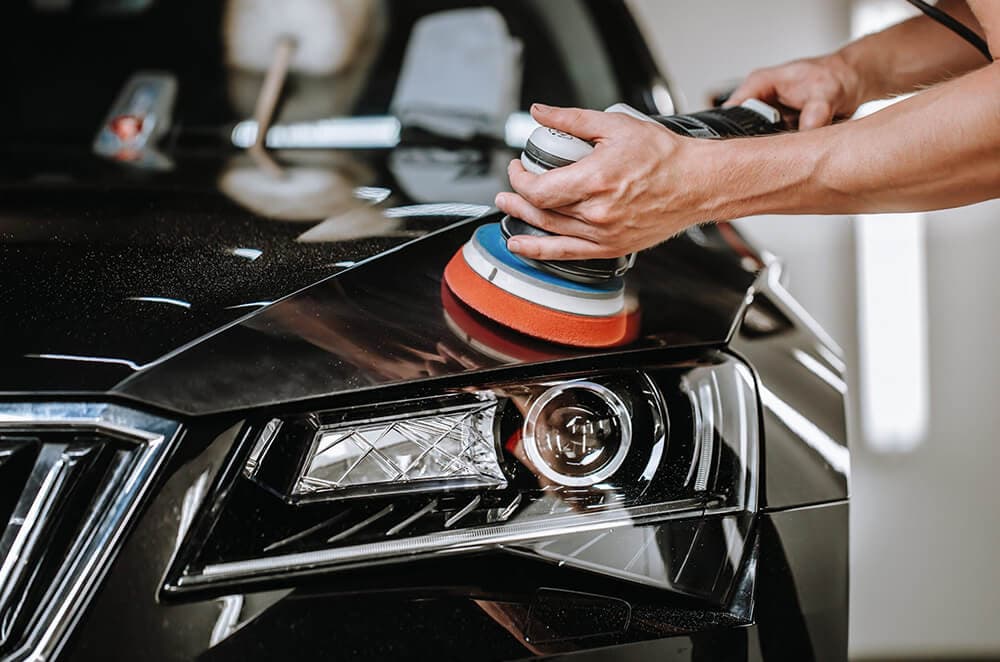
Why we inspect before accepting a job
Vinyl and PPF use adhesive: they bond to whatever is underneath and stay there for years. If that surface is not healthy, the material will not anchor and the edges eventually lift; if it is healthy but marked, the defect is sealed in and cannot be touched until the film comes off.
That is why the inspection is not a sales formality. It is the part of the job that decides whether we accept the car as it is, whether it needs preparation first or whether it has to go somewhere else before us.
The inspection under light
You can see almost nothing under the workshop's ceiling lights. Swirls from a brush wash, holograms from a quick polish and fine drying marks only appear under dedicated lighting or in full sun, and on dark paint they are what dulls the colour.
This is also when differences in texture between panels show up, often revealing a resprayed panel before we measure anything.
The paint thickness gauge
We measure the paint panel by panel. It serves two purposes: finding resprayed areas, where the reading jumps, and knowing how much room there is for correction without taking away too much clear coat.
If previous correction has already left the clear coat thin, there is no miracle polish: we correct less and state clearly what will remain. Using up clear coat for half a point more gloss under film helps nobody.
The hand test
After washing, a hand over the clean clear coat should glide without feeling grit. If it feels rough, there is bonded contamination: iron particles from traffic, tar or hardened organic residue.
You cannot see it, but you can feel it. Under clear film it remains as a series of permanent raised points, because the film settles over whatever profile it finds.
What decides a yes, a ‘sort this first’ or a no
- Flaking clear coat
- It cannot take film. The adhesive pulls at the weakened area during removal and leaves a worse result than the original problem.
- Rust or lifting paint
- It would keep spreading under the film, hidden until it was too late. This needs bodywork and paint before any film.
- Respray over filler
- It reacts differently to polishing than factory clear coat and its adhesion is uncertain. We warn you in writing, and sometimes exclude that panel.
- A scratch that catches your fingernail
- It has gone through the clear coat. Its appearance can be improved, not removed, and vinyl will follow whatever remains.
- Clear coat already thinned
- It can take film, but not another aggressive correction. We set out what can realistically be achieved and explain it first.
- Distorted or worn plastics
- Damaged trim and bumpers do not provide the same bonding surface. We assess them piece by piece.
What only appears once the car comes apart
Some defects stay hidden until trim or a handle comes off: a rusty edge, a resprayed area ending directly under the part or a clip that will not survive removal.
When that happens, we stop and call you. We explain what we found and what it means for time and price, and you decide. We never carry on by ourselves or add a charge without your approval.
What you can do before bringing the car in
- Send photos in full sun: swirls only show under direct light, never in a garage.
- Tell us if the car has had bodywork or paint, even years ago and on a different panel.
- Say whether it has vinyl or film on it now, or had it fitted and removed before.
- Do not wax it before bringing it in: wax and silicone have to be removed afterwards and do not help.
- Point out the areas that look worst to you, even if you think they cannot be fixed.
- Bring the car reasonably clean, but do not put it through a roller wash the day before.
FAQ
Can you reject a car?
Yes, and sometimes we do. If the paint will not hold the material, fitting it means charging for a job that will fail. We would rather say so first and explain what needs sorting.
Do I need to polish the car before bringing it in?
No. Preparation is part of the job and we do it after measuring the clear coat. A polish done somewhere else just beforehand can leave oils and holograms that then have to be removed.
Why do you ask for photos in full sun?
Because it is the only way to see the true condition of the clear coat without the car in front of us. In diffuse light, paint with years of brush washes behind it can look immaculate.
What if only one panel is in poor condition?
That panel can be left out of the job or recorded as an area where the risk was explained. What we do not do is fit over it without telling you and discover the problem when the film comes off years later.
Do you do bodywork and paint?
No. Our work is wrapping and PPF, plus surface preparation. If the car needs bodywork or paint, that has to be sorted first, and then we fit over a healthy surface.